Executive summary
On Monday 21 September 2026 the Rosetta Initiative held its kick-off workshop at Climate Week NYC, in partnership with Climate Group. Around thirty people took part under the Chatham House rule, drawn from banking, asset management, development finance, catastrophe modelling and reinsurance, analytics and index providers, philanthropy and the Global South. This document is the published record of what was said.
The premise put to the room was that insurance can already price physical climate risk, and that the rest of finance cannot read that pricing. The room largely accepted it, then corrected it in one respect that matters. Better analytics are necessary and they are not sufficient. Where nobody is required or paid to do the work, and no policy obliges anyone to act on the answer, a sharper curve changes nothing on its own.
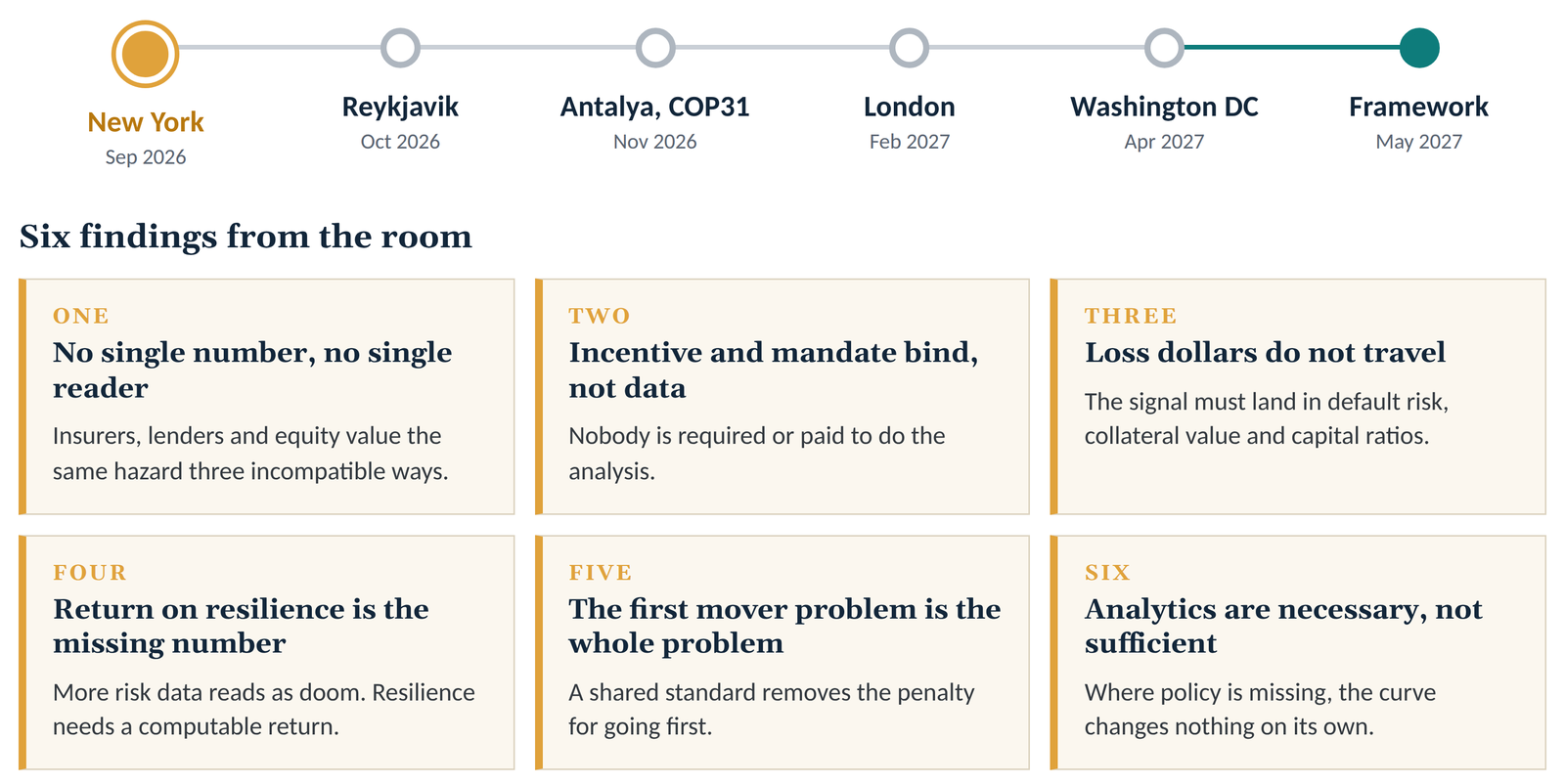
What the room asked for was not a new metric. It was for the financial metrics that already exist, the probability of default, the collateral value, the discount rate, the capital ratio and the debt sustainability assessment, to be fed a forward view of physical risk rather than a twelve month backward one. The headline deliverable may prove to be the return on resilience rather than the forward risk curve itself. The curve remains the instrument, but a number that prices avoided loss is what changes a decision.
The Rosetta Initiative
Insurance can already price physical climate risk. The rest of finance cannot read that pricing. That is the translation gap, and closing it is what the Rosetta Initiative exists to do.
With all the data that disclosure now gives us, why does climate risk still fail to translate into flows of finance at the speed and the scale required? Because the answer was never disclosure alone. Disclosure tells you what exists. It does not tell a credit committee what to put in the model, or a finance ministry what to put in the budget.
What is missing is the analytical infrastructure that turns disclosed climate and nature risk into valuation metrics. Insurance, catastrophe modelling and actuarial science already price physical risk with real precision, period by period, at defined return periods. Mainstream finance cannot read it. Physical risk arrives instead as a distant scenario rather than as a forward price curve, so it sits at a horizon where any reasonable discount rate washes it away, and capital arrives late, or not at all, in the places that need it most.
Serious work to close that gap is already under way, across insurers and reinsurers, catastrophe modelling and actuarial science, index, data and analytics providers, banks, asset managers and asset owners, supervisors and central banks, multilateral and development finance, and the communities carrying the risk. It is scattered, unmapped and short of critical mass.
Rosetta is a platform, not a product. It exists to map that work, to identify the gaps in it, and to bring it together under an agreed common action framework, so that it becomes coherent, comparable and interoperable. We do not build analytical tools or data products, we do not duplicate what others are already doing well, and we are not a competing standard. Rosetta does not build the translation layer itself. It builds the agreement that lets it be built. Rival handset makers agreed how to call each other, then carried on competing hard on everything else. What they agreed was the connectivity.
The workshop series, and this kick-off session
That agreement is built through a linked series of invitation only, closed door roundtables under the Chatham House rule, each of twenty to thirty people, deliberately connecting the communities that rarely sit at the same table:
- the catastrophe modelling and reinsurance community;
- investment bank, asset management and macro or central bank analysts;
- financial and prudential regulators;
- credit rating agencies, index and analytics providers, which are the fastest route into existing bank, asset manager and finance ministry workflows;
- economists and climate scientists, including attribution science; and
- impacted community and Global South representatives.
New York was the first. Reykjavik follows in October, COP31 in Antalya in November, London in February, and the World Bank and International Monetary Fund Spring Meetings in Washington in April. The series delivers a published Translation Layer Action Framework in early May 2027.
What this is
This is the report back from the kick-off workshop of the Rosetta Initiative, at Climate Week NYC 2026, hosted in partnership with Climate Group. It was circulated in draft to those who were in the room and to those who planned to be and could not make it in the end, it has been corrected by them, and this is the published version.
It is anonymised, pursuant to the Chatham House rule. Nothing in it is attributed to a named individual or institution, and where a point only makes sense with some context I have described it by broad function rather than by organisation. Participants are listed at the end, and those who sent written input afterwards and agreed to be named are acknowledged there too. Nobody is named against anything they said.
The conversation moved fast, I was chairing rather than taking notes, and this was assembled from two recordings of variable quality together with written notes taken in the room by my co-presenter Paula Pagniez. Several participants then corrected the draft, and four corrections of substance were made as a result. They are reflected in the text rather than flagged in it, and my thanks to those who took the trouble.
This document is the record. What I make of it is a separate matter and sits in a companion paper which will be revised after each convening and which is the living and evolving Action Framework until it is finalised in May 2027.
How the session ran
The plan was four questions in breakout groups, then three questions in plenary. As those in the room know that is not how it worked in practice. We ended up running one conversation for the full ninety minutes and I facilitated rather than chaired, taking contributions as, they came.
We therefore never worked through the questions in order, and no group ever reported back. What follows is my attempt to sort what was actually said against the pre-framed questions. The sorting is mine, and it is the part of this document most likely to be wrong. Several contributions belong under more than one question, and I have put them where they seemed to correspond most to a specific question rather than repeating them.
One consequence is worth stating. Running as a single conversation meant everyone heard everything, which is why the disagreements in section four are on the record rather lost inside five separate groups. Perhaps it cost us the coverage that breakouts may have given, and perhaps several people who wanted to speak did not get to. If that was you, please put it in writing now and it will carry the same weight.
Highlights: the eight things
- There is no single number, because there is no single reader. An insurer thinks in probability of loss, a lender thinks in creditworthiness and default, which is binary, and an equity investor thinks in future cash flows. Three parties looking at the same hazard and valuing it in three incompatible ways. The translation gap is not only between climate data and finance. It is between the parts of finance, which do not understand each other’s products well enough to know that they are looking at the same thing. Written input received since, from a body representing around four hundred and twenty institutional investors, puts this as a finding rather than a gap: for institutional investors there is not yet one consistently reliable number that translates physical climate risk into a change in investment decision. Their conclusion is that the useful common layer may be less about finding one universal metric and more about making the different metrics and decision frameworks already used across the financial system intelligible and interoperable.
- The binding constraint is incentive and mandate, not data or method. Almost nobody in the room argued that the analysis cannot be done. What they described was a system in which nobody is required to do it, nobody is paid to do it, and an anxiety that the first person to do it honestly may be punished for it. A sharper version has arrived since, from two sectors independently: institutions hold numbers they privately believe to be wrong, and what holds those numbers in place is that everybody else holds the same wrong number.
- Loss dollars do not travel. A number expressed as expected loss does not move a bank, because portfolios are diversified and it simply does not show up. It must arrive as collateral valuation, earnings at risk, probability of default, recovery rate or capital ratio. Translation means landing in the metric that already sits in the model, not publishing a better loss figure.
- The missing number is the return on resilience, not the risk. Pushing more risk data into the system was described, more than once, as changing very little, because it reads as doom and cannot be acted on. The question that changes behaviour is how an actor computes the return on a resilience investment, and that is a different calculation from measuring the hazard. One proposition put in the room was that the catastrophe models themselves are where that calculation ought to be built, since they are already the machinery for it.
- The first mover problem is the whole problem. It appeared in three separate forms: in technology, where the first, second and third of a kind never make money and the sixth and seventh do; in disclosure, where the first honest long horizon view is commercially punished; and in consumer markets, where buyers take the cheaper price now unless the whole industry moves to the same methodology. Everyone wants to be sixth. Nobody will be first.
- Clarity does cause capital flight, and it has already started. This was the sharpest disagreement of the afternoon, and it was not resolved. It is not a theoretical objection: a lender has already screened tens of thousands of individual mortgage points and moved to shed the most exposed decile on the grounds that it will become uninsurable. The honest answer is not that the fear is wrong, but that the correction comes either way and a forward view is what turns it from a cliff into a schedule for investment.
- The insurance model will not change itself. The twelve-month renewal is not an oversight, it is a design that removes any need to hold a view beyond twelve months, and the sector is not confident enough in its own long horizon loss curves to publish them. The room’s conclusion, put most bluntly by those who have worked inside it, was that policy and regulation will have to drive this.
- And the challenge to all the above: pricing is not the only blocker. The first contribution of the afternoon was a caution, and it is worth recording, though it should not be asked to carry more weight than it can. It was made about agriculture in the European Union, where farmer resistance to recent proposals under the Common Agricultural Policy has slowed the rule making, and where the rules do not arrive the financing community cannot offer the products that would carry the money. A better price signal does not cure that. Where the point leads is set out in the companion paper.
Round one: the four questions
1. What number or numbers would have to change for a physical climate risk to change a material investment decision?
The room named numbers readily, and they fell into four pillars.
Credit and lending
- Credit ratings barely move. One figure cited in the room, from a credit rating agency, is that around one per cent of credit ratings would change on the basis of physical climate data over five or six years. The same is true inside banks’ own tools, and inside the tools that supervisors and regulators expect those banks to use.
- Recovery rate assumptions are effectively static, set by seniority of debt. They do not contemplate that in a climate related credit event the assets underpinning the valuation may be uninsurable or simply gone.
- Probability of default is the number that matters, and physical risk does not reach it. Tenors are short, exposures can be securitised, and there is a standing expectation of government support, so the risk is diffused across the economy rather than landing on any single credit. It only becomes visible when it is added up at the macroeconomic level, where in a country such as Brazil the effects are already significant enough to be macro critical.
- Collateral valuation and earnings at risk were both named as the metrics that would register, precisely because expected loss does not.
- And a qualification from the investor side, received in writing since. What investors care about is residual risk. Insurance pricing is an important signal but not a complete measure of underlying exposure or resilience, and while insurers are better equipped to price certain acute physical risks, chronic and longer horizon risks and wider system effects are harder to capture through an insurance price alone.
Asset values
- For infrastructure and real estate, the number named was a fall in the value of a critical infrastructure asset of ten to fifteen per cent over the next few years. Double digits matter because that is roughly the annual equity return on most infrastructure assets. At that level people turn and pay attention. Written input since has clarified the scope of that figure. It describes a mark-down at the point of sale, from one investor to another, on an asset held by an infrastructure fund manager, linked to that asset’s vulnerability to physical climate risk. It should not be read as a threshold holding across institutional investors generally, for the reasons set out under the next question.
- The observation behind it: assets may be built to last decades, but concession and public private partnership assets change hands every five to ten years, so the value at sale is the number that disciplines behaviour, not the design life.
The corporate income statement
- Percentage of profits at risk was reported as the translation that works with chief financial officers of large industrials. Run across the Fortune 500 it averages around eight to nine per cent, with a wide spread around that average, some companies considerably higher and some considerably lower.
- The device that makes it land is the date. Asking what a company’s annual expected loss will be in 2030, when the same chief financial officer will still be in post and it will be their bonus at stake, moves the conversation from compliance to share price. And it allows the second half of the sentence: here is the investment that brings it from nine per cent to five. The internal pushback reported was that no chief financial officer has ever asked for this. The answer given was that they should have.
The price of risk itself
- Not a score. The point was made forcefully that the risk industry has distilled climate into scores, and that chief executives and chief financial officers do not want to be told a thing is a four or a seven. They cannot make a decision on it. What is missing is the translation of that exposure into a cost curve.
- A climate risk cost curve, built for the perils that matter to the asset such as flood or wildfire, over the life of that asset rather than just a twelve-month premium. It is a monetary indication of the asset’s future insurability. It was also suggested that the same logic can extend beyond physical risk to transition risk. It was speculated that such curves may run in the opposite direction for clean technologies, where performance risk starts higher and falls, while for high carbon assets it may start low and rise. That asymmetry is invisible in a twelve-month cost of risk horizon and may change how both are valued.
2. What stops that number existing today for climate risk? Data, method, mandate, incentive or liability.
The room was asked to choose one. In practice the weight fell heavily on incentive and mandate, with liability rising fast, and data and method treated as real but solvable.
Incentive, which was the majority answer
- The twelve-month contract. If the policy reprices annually, there is at first blush no incentive for the underlying models to form a view beyond twelve months, and no carrier will offer a multi-year premium curve. The practical test offered: ask an underwriter how far your premium would fall if you made a given adaptation investment, and the answer is to make the investment first and come back afterwards. Which is of no use at all to the person deciding whether to make it. The question this raises is why insurers do not see themselves as the derisking and resilience partner to their clients. A longer-term partnership to maintain a client’s insurability looks like a gain on both sides. It would avoid the public opprobrium insurers will face as they are forced to withdraw cover for risks such as flood, as at Tenbury Wells. It would keep paying clients and deepen their loyalty to the insurer who kept them insurable. And it does not necessarily require any shift away from a contract priced annually.
- First of a kind. In technology the first, second and third movers do not make money and the sixth and seventh do, so everybody queues to be sixth. The counter example given was state backed capital, which accepts early losses to climb the learning curve and descend the cost curve, and by the time the return is visible the position is unassailable. Solar and electric vehicles were the illustrations.
- The closed-door test. At a session with some fifty multinational chemical companies, every one said it would invest in clean energy technologies the moment a carbon tax arrived, and not one would move before it. The tax has not arrived and is not expected to. The question left on the table was what mechanism gets everyone to move together in its absence.
- Tenure. Average chief executive tenure is about five years. The resilience investments under discussion benefit a successor two or three removes away. One answer to the short horizon objection, wherever it appears in this document, has been offered since. A project with a three- or four-year exit horizon is still affected if insurability collapses inside the buyer’s window, because the exit price embeds the next owner’s forward view. A short holding period does not insulate you from the long horizon. It transmits it into the valuation at sale.
Mandate
- It does not appear in the tools that supervisors and regulators require. Banks are driven by their regulators’ risk models, insurers by theirs and by the catastrophe models. Neither set of tools makes physical climate risk look like a large enough problem to act on. A number has been put on this since: it takes around eighteen months to get a change to a credit model approved by the regulator, which is a large part of why credit officers stay with the models they already have.
- A consultation with more than a dozen banks on physical risk in agriculture, the most exposed sector, found unanimous agreement that the risk is far larger than the financial sector recognises, and a final conclusion that the binding constraint was neither metrics nor fiduciary requirements but real economy policy in the agricultural sector itself. The same point was made from the other end of the same sector: farmer resistance to recent proposals under the Common Agricultural Policy has slowed the rule making in Europe, and where the rules do not arrive the products cannot follow. That is not a pricing failure, and better pricing does not cure it.
Habit, which is also not one of the five
One of the sharper interventions of the afternoon was not about capability at all. There is a great deal of data, finance objectively quantifies all sorts of things, and in this case it simply does not, which is a choice rather than a limitation. The comparison offered was engineering: you do not design a bridge by applying a discount rate to the risk of it falling down, you evaluate the risks explicitly and then build it so that it is very unlikely to fall down. Companies fall down all the time, because they do not think like that. The blunt version, which was put to the room as a question about our own families rather than about our balance sheets, is that nobody in finance is paid to care what happens in ten years and so nobody does.
Liability, which is growing
- A United States data vendor that attaches a physical risk component to residential property values is reported to be facing substantial litigation from homeowners. In a litigious market, publishing the metric is itself an exposure, and that needs designing for rather than wishing away.
- The mirror image is the fiduciary question set out under round two below, where the liability may soon attach to not producing the number.
Data and method, which are real but tractable
- Harmonisation is the cost, not collection. The European agriculture study had to gather data across twenty-seven member states, held in different forms by different institutions, fill the gaps and then harmonise across twenty-seven regimes. It was hard and it was done, which is the point.
- Data quality is not where people think it is. Equivalent work in Brazil found the data better in quality and more harmonised than across the European Union.
- The standard pushback needs an answer. A recent United Kingdom regulatory report finding poor correlation between physical risk factors and real estate outcomes is now routinely produced to close this conversation down, and the room asked directly how that is to be countered.
- Scale invariance. Metrics are needed that hold at asset, portfolio, sector and sovereign level, rather than a different construct at each.
The market mechanism that is missing
- There have been very few climate related default events. What the market has seen instead is balance sheet interruption and outage, which does not force a repricing.
- The precedent is instructive. In the credit markets of the 2000s it was sequential defaults that made people reach for derivative instruments to hedge the exposure, and it was that demand which in turn forced better valuation of credit. The uncomfortable implication is that the same sequence for climate arrives only after the defaults, at which point the question becomes whether the information had been available all along.
- The one pocket of genuine appetite reported is the hedge fund space, where the observation is that the market is trading a long way from where these instruments should be priced. The obstacle there is holding period: how long would you have to hold the position for being right to turn into cash?
And two further obstacles that belong under none of the headings
- Opacity and mistrust, and an important market perception correction. The market reference catastrophe models are not owned by the reinsurers. The two that set the reference for pricing and solvency are owned by a ratings group and by an independent listed analytics firm, alongside perhaps twenty niche players covering particular perils, regions or sectors, and several carriers and brokers maintain in-house interpretations for their own use. The reference models function as the word processor and the spreadsheet of the market: they are used because they let brokers and underwriters communicate as transactions are made. They are nonetheless not easily accessible to the clients whose risk they price, and there is a widespread assumption among governments that they are being substantially overcharged for hurricane risk, with premiums rising faster than the underlying risk. Whether or not that is true, it is now a material obstacle, and dispelling it requires a transparency that does not currently exist. One counterexample arrived while this document was in circulation: a flood modelling firm now owned by a major reinsurer has made its United Kingdom flood model freely available.
- A harder version of the same point was put by an analytics provider working with global banks on mortgage portfolios: that the insurers’ own models are not taking climate change into account, that they hold to their existing curve, and that in this provider’s view the curve is broken. The practical consequence described was that banks are advised not to bring their insurance teams into the exercise, because when the point is put those teams disengage. Whether or not one accepts the judgement, that a serious analytics house is routing around the insurance function is something to take seriously.
- Commercial pressure inside the modelling teams. It was reported, from conversations with three separate companies in an unusually well supplied market, that catastrophe modelling teams are under pressure to moderate their conclusions on risk so that underwriters can compete on price. If that is a fair description, the independence of the risk view is itself under strain at exactly the moment we are proposing to build public infrastructure on it.
- And a candid statement from the reinsurance side: the industry does not offer the forward view because it is not confident enough in its own loss curve projections, with actual losses running off those curves in some areas. The counterpoint is that you have to start somewhere. The first version will never be as good as the fifth. Had Ford waited until it could build something equivalent to a modern electric car, there would have been no Model T, and no industry to improve on it.
3. What would you need to see, and from whom, before you would use an 8 to 15 year forward loss curve in a live decision?
This produced the most practical material of the afternoon, and almost all of it pointed at public institutions rather than at the market.
A common platform, bought once
- The example that most caught the room: a monetary authority in Asia purchased a single climate risk platform and gave all one hundred and fifty of its banks access to it. That removes at a stroke the procurement excuse, the comparability excuse and the argument about whose numbers are right. Conversations have been running for some three years with a second Asian regulator about replicating it, and at least one participant has been making the same case there.
- Open access tools, at least as a demonstrator, so that governments can use them to frame policy. The argument was not that everything must be free, and there will always be room for commercial versions. It was that you cannot federate a large number of institutions around a tool they do not understand and have never used, and a public demonstrator is what breaks that barrier.
A public mandate, and a public private structure
- The European agriculture work exists because public institutions commissioned it, and the question they asked was narrower than it is now often remembered. They wanted to know whether European farmers were adequately insured against climate risk today, and whether that would continue to hold as the climate changes. It was a genuine policy knowledge void rather than a known cost somebody was trying to size. The forward risk modelling was not in the original scope at all. It was argued in, on the grounds that the question could not otherwise be answered, and that supporting technical work has since become the main story. The figures, which three people have now given independently, are an annual average loss of around twenty-eight billion euros today against a probable maximum loss of up to sixty billion, rising on a business-as-usual path to around forty billion and up to ninety billion by 2050. The two metrics are distinct and should not be run together.
- Demand from finance ministries is real and unmet. Governments are saying they need an agricultural insurance market which does not come with a large protection gap or is almost non-existent in many countries. To close the protection gap will probably require public guarantees and caps at first, and they have no tool with which to have that conversation. Written input since adds a problem that comes earlier still in many markets. Insurance penetration is very low to begin with, and unpredictability of premiums makes it worse, creating a chicken and egg. It is not unusual for farmers to try insurance for a couple of years, drop it, then suffer a loss and regard the premiums they paid as wasted. On that reading a predictable premium path is a precondition for persistency, and persistency is a precondition for penetration at all, which gives the forward curve a different and larger job outside the markets that are already covered.
- There is a policy counterfactual missing too. When a finance ministry assesses the costs and benefits of a climate or resilience policy, it has no forward figure for what not acting will cost, so the decision is taken without one half of the arithmetic.
Translation into the metrics that already exist
- The curve must arrive as collateral valuation, earnings at risk, probability of default and capital ratios, not as loss. This was the single most repeated practical request of the afternoon: get from a dollar loss value into the metrics that are actually useful to a bank, including those used in project finance.
- A serious worry was expressed that half of financial services now believes its job is to model every client at asset location level from scratch, and that this cannot be the answer. Where is the common ground with what insurers already model, so that the wheel is not reinvented inside every institution. Proprietary constraints are understood, but there must be something better than this.
- Project finance due diligence was noted as an existing source of exactly the asset level information required, already collected for other purposes.
- And the specific technical proposition: that the catastrophe modelling machinery is where the return on resilience calculation should be built, rather than in a new and separate construct.
Somewhere to prove it
- A heavily exposed sector was the preferred route, with agriculture named repeatedly, and Brazil named more than once as the strongest candidate territory on grounds of data quality and of a government willing to sit down with the industry and work out what public private mechanism would build an insurance market.
- A territorial or district approach was proposed and has since been clarified by those who offered it as a complement to the sectoral route rather than an alternative to it. A sector curve still has to be applied to particular assets, lenders and regulators, and a district is where that application can be tested. A cohort of twenty districts was offered as already available, with concessionary finance being arranged, and an explicit invitation to link this to the five-year work programme running through COP31 and COP32. Each district in that cohort already produces a capital and operating cost model, a risk map and an infrastructure financing pathway, which are precisely the inputs a return on resilience calculation needs.
- Agriculture and food security were flagged as the likely centre of gravity at COP31 and COP32, which are working closely together, and that makes the existing European agriculture curve unusually well timed.
And the honest condition
- Whole of industry agreement on methodology. Otherwise, as one contribution put it, the consumer, the corporation or the government will always take what is cheaper right now, and it does not matter whether the product is property insurance or health insurance.
4. Are fears justified that providing clarity on future climate risk could make things worse rather than better?
This was one of the most important exchanges of the afternoon and it was not settled. I want the draft to record that honestly rather than ignore it.
The case that the fear is justified
- It is already happening. A global bank screened ten thousand individual mortgage points across its portfolio, ranked them, and moved to shed the most exposed ten per cent on the grounds that those properties will become uninsurable. Lenders are ahead of insurers here, and they are not waiting for a published curve.
- Pricing climate risk properly brings a correction forward and causes real hardship to real people, and there is published work on United States mortgages that reaches a pessimistic conclusion on exactly this.
- There is no safety net in most markets. The United Kingdom has Flood Re. The United States does not, and in a litigious market the vendor publishing the number gets sued.
- And the consumer test is unforgiving. Tell a homeowner in a wildfire exposed part of California that this is their premium this year, three times that next year and eight times in two years and ask whether they will buy. Unless the entire industry has agreed the methodology, they will simply go to whoever is cheaper this year.
The case that it is not, or not the whole story
- The correction arrives either way. The choice is not between disruption and no disruption; it is between a managed repricing with a decade of warning and a disorderly one at the point when nobody can avoid it any longer.
- A curve read as an investment schedule rather than a verdict changes what it does. The gap between an unadapted curve and an adaptation adjusted one is the value of resilience, in money, by year. That is the same document turned the other way up.
- Resilience is beginning to be priced, in small ways. A proliferation of managing general agents in the United States is now pricing on resilience and on the positive impacts of nature-based solutions. Natural capital funds in the United Kingdom have raised from local authority pension money against metrics such as peak water flow and flood risk.
- And the counter evidence is uncomfortable: asset owners who have invested heavily in resilience report that it has not been reflected back to them. Until it is, the fear is not irrational, it is accurate.
- The United Kingdom has a live test of all of this. The assumed end of Flood Re in 2039 is now contested, and an open letter went to the Chancellor, the Financial Conduct Authority and the Prudential Regulation Authority on the day of this workshop, calling for that decision to be reviewed and for supervisory powers to be used on the growing uninsurability of flood prone communities.
My own position, for the avoidance of doubt, is that the fear is real yet not unsolvable, and that the answer is design rather than delay. But it is the question I would most like the Rosetta Initiative to keep working on, because if we get it wrong the initiative does harm.
Round two: the three questions
5. Who in this room can move first without being punished for it, and what do they need from everybody else?
The short answer the room gave was no private actor, alone. That is not a failure of will, it is the structure. What followed was a list of the actors for whom the structure is different.
- Public authorities that may be carrying a loss they cannot see. The European Commission commissioned the agriculture work because it did not know whether European farmers were adequately insured, or whether the public purse was standing behind a risk the market had not priced. It is the asking that starts this, not the knowing, which is a lower bar than it first appears and one available to any authority that suspects it may be exposed. It is therefore key to map the costs that are already falling, and who is picking them up now without being aware that these are the costs of climate. In many cases that will be the public, through government. Public agencies can be shown what they are already absorbing and how it grows year on year. Either they budget for it under business as usual, or it stimulates policy action to reduce those costs, or to attribute them to those most responsible for causing them. It should also make policy to mitigate, to adapt and to build resilience look considerably less costly to a finance minister when set against the cost of not acting.
- Candidates in emerging markets, supplied in writing since by a bank that operates in them. Agribusiness, where forward curves on the cost of insurance against crop damage and loss would support adaptation investment, partly by creating what was described as counter-factual jeopardy for asset owners and existing lenders, and where agricultural supply chain work could carry the signal down to smallholders. Commercial real estate and urban municipalities, where infrastructure that looks sound when built comes undone for want of features taken as read elsewhere. The example given was drainage specified for a one-in-a-hundred-year event that now arrives one year in ten, or annually. A forward curve moves such features from nice to have to must have, ideally enforced as a condition of lending, or pushes developers towards less vulnerable sites. The same logic was flagged for beachfront tourism, and at a stretch for power systems and transmission grids. And data centres, where some of the worst practice may sit in emerging markets and where data on whether a site remains insurable into the future would be useful.
- Regulators and central banks, by procurement as much as by rule making. Buying one platform for the whole system, as described above, is a first move that costs the individual bank nothing and cannot be punished.
- Multilateral and development institutions, which are already moving. Work is under way at one to update its pricing tools for public sector insurance. An example was also given of a deferral mechanism applied to an institution’s own debt exposure to countries, giving immediate relief on an event without requiring a declaration of emergency. The associated difficulties were described candidly: affordability, the design of triggers, testing real demand, and whether a solution that always relies on concessional finance is sustainable at all. The point was made that the public sector faces the same reluctance as the private one, because no government wants to spend today on a benefit that accrues after it has left office.
- Data specialists with conviction. Those approaching primaries and reinsurers with new data are being told, in effect, that if they are confident in it they should set up their own underwriting vehicle. That is a first mover route that exists today and is being taken.
- And the structural answer: standardisation removes the penalty. If the basis is common and the requirement is universal, being first is no longer a competitive act. That is precisely the coordination failure that prudential regulation exists to solve.
One further proposition, which I record because it was the most ambitious thing said all afternoon: that the real task is to work out how, in a capitalist system, the risk and the finance can be made to work across the whole ecosystem so that first loss is crowdsourced collectively, accepting a temporarily lower discount rate, on the understanding that the pie on the other side is bigger. The same contribution carried its own condition, and it is the sentence I keep coming back to. Without regulation, it will not happen. Is that true, and how would we test it?
6. What does resilience have to earn to read as a credit against the risk, and not only as a discount?
- A dollar figure on the avoided loss. There is work under way putting an actual value on the resilience benefit of investment in nature, including avoided flood and drought, and that is the shape of what is needed.
- Return on resilience investment as the headline metric. The room was clear that this, rather than a sharper hazard number, is what would change decisions.
- Evidence that is now arriving. Soil measurement remains nascent but mapped against remote sensing and artificial intelligence modelling it is producing accurate pictures of soil health, and of the correlation between soil health and yield, tested across both a drought year and a very wet one. Data providers are having more success with banks on mortgage terms than with insurers.
- Instruments that already work this way. Long term offtake agreements for nature-based investment, modelled on how the renewables market was grown, and natural capital funds paying out against physical metrics.
- Two transmission channels, not one. Insurance carries the acute or tail risk signal, and at some point, it becomes withdrawal or unaffordability. Lenders carry the chronic risk signal and can tell infrastructure equity that its cash flow projections must be rebased to reflect chronic risk in revenue, operating costs and capital forecasts. The second channel is the underused one.
- And a reframing that several people found useful: insurance understood as contingent capital markets, the part of the capital markets responsible for providing pools of contingent capital that are there if defined events occur, and therefore an integral part of the capital stack rather than a service bought alongside it.
7. What is the role of policy makers, and especially of prudential regulators?
- To require what the market will not volunteer. The clearest statement of the afternoon on this came from the reinsurance side: the industry will not offer the forward view through the policy, so policy and regulation will have to drive it. The obstacle was stated most cleanly in written input since: prudential regulation, meaning Solvency, Basel and current interpretations of fiduciary duty, is fundamentally designed to look backwards, which is why a forward view has nowhere to land.
- Capital ratios. Lenders may have to adjust capital held against assets to reflect the physical risk embedded in them. That is where several people thought regulators should come in, because it makes the chronic channel bite.
- Supervisory tools. The tools supervisors currently require are part of why the risk is invisible. Changing the tool changes the behaviour faster than changing the disclosure.
- Public procurement of shared infrastructure, per the monetary authority example.
- Public guarantees and caps to stand up markets that do not exist, notably agricultural insurance in Europe.
- Rules that allow the products to exist at all. Per the caution at the top of this document, where resistance from an affected constituency slows the rule making, as it has with the Common Agricultural Policy proposals in Europe, no amount of analytical clarity will bring the financial products into being.
- The United Kingdom, both as a live case and as a lever. Flood Re after 2039 is the immediate question, and the open letter of 21 September is the opening move. More broadly, London remains the global insurance market, so changing how London regulates and understands insurance ripples worldwide. That is the argument for the Rosetta Initiative workshop scheduled for London in February 2027.
Fiduciary duty, which may be the sharpest instrument available
Trustees, directors and asset managers who owe a fiduciary duty already rely on forward cost and price curves when taking and assessing decisions. They do not have one for climate risk, which may in practice limit the scope of what fiduciary duty can currently require of them.
The live question, and it is genuinely live: once directors and trustees become aware that such curves can be produced and given a monetary value, does fiduciary duty require them to commission one? Are you in dereliction of your duty if you do not ask? Leading legal opinion in London is currently about evenly divided. Alongside that sits capacity building and the possibility of strengthened directors’ legislation in the United Kingdom and elsewhere.
A related and very concrete asymmetry was identified. On a merger, acquisition or project finance transaction, insurance due diligence is a twelve-month snapshot of coverage. It says nothing about insurability in year two, three or ten. Environmental due diligence on the same transaction routinely gives a forward view over a decade. The systematic mispricing of long-lived assets follows directly from that difference, and very few people outside the process realise it.
Four things which are influencing my views
- The translation gap runs inside finance, not only between climate science and finance. I had been describing a gap between those who produce risk analytics and those who allocate capital. The room made a more uncomfortable point: banks do not understand insurance, insurers do not understand lending or equity, and the same hazard is valued in three incompatible ways by people who do not know they are disagreeing. A basic piece of mutual education may be a prerequisite for the technical work rather than a by-product of it. Increasingly we are seeing a hybrid finance-insurance professional emerging who sits between the two, a kind of Rosetta Stone role in its own right.
- The headline deliverable may be the return on resilience rather than the forward risk curve. The curve remains the instrument. But more risk data on its own was described as changing very little, and the metric that moves capital is the computable return on a resilience investment. That is a shift of emphasis in how the work should be framed, and it matters for how it is funded and received.
- The capital flight objection deserves a workstream, not a paragraph. I had treated it as an objection to be answered. Given that a lender is already shedding its most exposed mortgage decile, and that a data vendor is being sued for publishing property level risk, it is a live consequence to be designed for. I am considering if this should be a standing item at every remaining convening.
- And the correction I least expected: the analytics are necessary, but they are not sufficient. I have been arguing that we have a translation problem rather than a data problem. The room did not dispute that, but it added a second condition. Where the rules do not permit the product, or where the real economy policy is missing, the curve changes nothing on its own. The agriculture consultation reached exactly that conclusion, and the caution about farmer resistance to the Common Agricultural Policy proposals made the same point from the other end of the same sector. That is the uncomfortable part: agriculture is the one sector where the forward curve already exists, and it is still the politics that bind. The framework therefore needs to say what has to be true in policy, not only what has to be true in analytics, or it will be accurate and inert. Where these four lead is the subject of the companion paper rather than of this one.
What the room did not contain
Two absences are worth stating plainly, because they shape what this document can and cannot claim.
No serving underwriter from a carrier or reinsurer was in the room. The insurance capability present was advisory, academic, analytical and recent rather than current. That means the supply side was described by people who have been in the industry, who know it extremely well, and in some cases with a candour that current employment would not permit, but it was still described rather than represented. Reykjavik and the London session in February are built to correct that, and I would be grateful for introductions.
And the frontline and Global South voice was thinner than intended, for reasons of cost and of scheduling in the busiest week of the year. Several of the most useful proposals of the afternoon, on territorial pilots, on Brazil and on agriculture, point directly at those constituencies, so this needs fixing before COP31 rather than after it.
One prediction, on the record
I record this separately because if it is right, it changes the timetable for everything above. The view was put, from the reinsurance side, that 2027 will be the year that resets thinking about physical climate risk exposure, in agriculture and in physical losses alike, and that we will be back in this room in a year discussing not only very large losses but mass casualty events arising from an extreme climate year. The conclusion drawn was that the market should be thinking about resetting now, rather than absorbing body blows that neither the insurance sector nor the wider financial sector will be able to take later.
The case for doing this work does not depend on that forecast being correct. It is considerably sharpened if it is.
What happens next
This phase is supported by The Sunrise Project, which funds the workshop series and the publication of the framework at the end of it.
What happens now
- The invitation stays open. Comments closed before publication, but corrections do not. If something here still misrepresents what you said or what you meant, tell me, and the next version of the companion paper will say so.
- Name one number, if you did not get to speak or did not get to finish. Round one, question one asked what single number inside your own institution would have to change for a physical climate risk to change a decision. Those answers are the specification the London session in February will work against, and a sentence by email carries the same weight as a sentence in the room.
- Introduce me to one underwriter, catastrophe modeller or actuary who should be engaged in this workshop series. No serving underwriter from a carrier or reinsurer was in the room on 21 September, and that remains the single biggest gap in the work.
- Tell me if you want to carry something forward. Several proposals in this document need an owner rather than a mention: the territorial pilot, the Brazil case, the fiduciary duty question, the open access demonstrator, the return on resilience calculation inside the catastrophe models, and the capital flight workstream.
Participants, and those who contributed afterwards
Around thirty people took part, under the Chatham House rule, representing the institutions listed below. Nothing in this document is attributed to any one of them.
- Arc Connect
- Barclays
- Bezos Earth Fund
- Bloomberg
- Caribou
- Centigrade
- Ceres
- Climate Champions team
- Climate Finance 2050
- Climate Risk Group
- Deloitte
- Earth Security
- Federated Hermes
- FJGET
- Georgetown University
- Green Finance Institute Transition Finance Lab
- Imperial College London
- MIGA, World Bank Group
- Mitiga Solutions
- Natural Capital Reserve
- NatWest Markets
- Penn Engineering
- Pottinger
- S&P Global
- The Sunrise Project
- Systemiq
- XDI
One further colleague of the Climate Champions team was also in the room; the name is still to be confirmed and will be added. Chaired by Anthony Hobley, Founder, The Rosetta Initiative.
Apologies on the day, from those who had planned to be there and whose comments have shaped this document since: Dave Jones, Ember and UC Berkeley; Tom Kagerer, Vlinder Climate; Emma Knight, IIGCC; Hiba Larsson, Naia Trust; John Murton, Standard Chartered; and Lucca Rizzo, Instituto Clima e Sociedade.
Written input after the workshop materially improved this document, and several contributors asked to be named for it. With thanks to Paula Pagniez, who co-presented and whose notes corrected a good deal of it; to Alexandre Chavarot, Founder, Climate Finance 2050 and Vice Chair, Green Finance Institute Transition Finance Lab; to Valentina Ramirez and colleagues at IIGCC, whose written response on the investor view is reflected in several places above; to Nadia Humphreys, Bloomberg; to John Murton, Standard Chartered; to Mike Clark, Ario Advisory; and to Neil Khor and Max Nathanson of the Climate Champions team.
A note on the companion paper
This document records what was said. It does not say what I think it means, which is a different kind of claim and belongs in a document that carries my name rather than the room’s. That companion paper, which is to follow shortly, takes the material here, together with the conversations that have followed, and sets out the conclusions I am drawing, the questions I want the next convening to settle, and the first shape of the action framework. It will be revised after Reykjavik, after COP31, after London and after Washington, and the version published at the end of April or in early May 2027 is the framework itself. Anyone who would like the current version should ask.
Anthony Hobley, Founder, The Rosetta Initiative, anthony@anthonyhobley.com
rosettainitiative.org. LinkedIn: linkedin.com/company/the-rosetta-initiative